
• Skip to main content
  • Skip to header right navigation
  • Skip to site footer
  • Home
  • About Denise
  • Forms
  • Fees & Policies
  • Online Classes
  • Upcoming Events
  • Contact
  • 713-823-4001
Denise O’Doherty

Denise O’Doherty

Licensed Professional Counselor, Licensed Marriage and Family Therapist, Drug and Alcohol Counselor, Registered Nurse

  • Relationship Counseling
    • Couples Therapy
    • Marriage Counseling & Family Therapy
    • Premarital Counseling
    • Domestic Abuse Counseling
    • IMAGO Relationship Therapy
  • Substance Abuse
    • Alcohol & Drug Addiction
    • SALCE Evaluations
  • LGBTQ+
    • Lesbian Therapy
    • LGBTQ+ Couples Therapy
  • Other Areas of Practice
    • Anxiety/Depression
    • BiPolar Disorder
    • Codependency/Personal Boundaries
    • Grief Counseling / Grief Therapy
    • Love Addiction/Love Avoidance
    • Overcoming Shame /Increasing Self-Esteem
    • Post Traumatic Stress Disorder
    • Dissociative Disorders
  • Gender Identity
    • Parents of Transgender Children
    • Gender Dysphoria
    • Cross-Dressing
    • Adult Children of Transgender Parents
  • Articles

Home » relationship counseling » Page 6

relationship counseling

BY Denise O'Doherty

10 Tips To Gain Emotion Health, A Happier Life, & Stronger Relationships
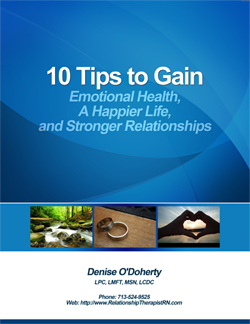
10 Tips To Gain Emotion Health, A Happier Life, & Stronger Relationships

free-report-coverpage
CLICK REPORT COVER TO DOWNLOAD

A Special Note From Denise

It is no secret that we all want to feel happy, and each one of us has different ways of getting there.

Did you know that happiness, joy and peace are your natural state of being? Yes, it is. Every other emotional feeling is a learned response to circumstances… everything!

You have inadvertently learned to feel the way you are feeling right now, learned to settle for less than you really want, to make choices that fall short of happiness, and to accept not having your needs met. In fact, you may have mistakenly come to believe that’s just how life is. But, what you have learned is now holding you back like invisible, elusive walls.

Happiness is not something you have to strive for or achieve. It’s a state of being that happens when your needs are being met and you are in balance.

Depression, anxiety, frustration, anger, worry, stress, lethargy, guilt, fear, abandonment, judgment, grief, sadness, victimization, suicide, and every other negative state is simply a result of not getting your needs meet … of not knowing how to get your needs met. In this state you are out of balance, disempowered. Your life spins out of balance and spirals downward … or it simply stalls and you go nowhere.

There is hope! There is a way to stop this cycle and reach your emotional and happiness goals. Stop settling, and begin to live again.

Here are ten steps that you can take to increase your emotional health and bring more happiness into your life.

I hope you enjoy this information and it helps you in living a more happy life.

Sincerely,

Denise O’Doherty

Filed Under: couples counseling, Marriage Counseling, premarital counseling, relationship counseling, self esteem, self esteem counseling
BY Denise O'Doherty

Robin Williams’s Death: A Reminder That Suicide and Depression Are Not Selfish

Courtesy of Mashable.com

Most of us can think of at least one Robin Williams role that brings an instant smile to our face just thinking of his comedic genius and ability to make us laugh. With the news of his death from an apparent suicide as a result of suffering from severe depression, we can’t help but ask the question, “how can someone that seemed so happy on the outside, be hurting so much on the inside?”

The Guardian addressed the issue with depression and how it can be overwhelming difficult to deal with for some people. The article brought great insight on those suffering from depression.

News of Robin William’s death due to apparent suicide, said to be a result of suffering severe depression, is terribly sad. But to say taking your own life because of such an illness is a ‘selfish’ act does nothing but insult the deceased, potentially cause more harm and reveal a staggering ignorance of mental health problems

Many words can be used to describe Robin Williams. ‘Selfish’ should not be one of them. Photograph: Allstar/Universal PicturesSportsphoto Ltd.

News broke today that Robin Williams had passed away, due to apparent suicide following severe depression. As the vast majority of people will likely have already said, this was terribly heart-breaking news. Such an iconic, talented and beloved figure will have no shortage of tributes paid to him and his incredible legacy. It’s also worth noting that Robin Williams was open about his mental health issues.

However, despite the tremendous amount of love and admiration for Williams being expressed pretty much everywhere right now, there are still those who can’t seem to resist the opportunity to criticize, as they do these days whenever a celebrated or successful person commits suicide. You may have come across this yourself; people who refer to the suicide as “selfish”. People will utter/post phrases such as “to do that to your family is just selfish”, or “to commit suicide when you’ve got so much going for you is pure selfishness”, or variations thereof.

If you are such a person who has expressed these views or similar for whatever reason, here’s why you’re wrong, or at the very least misinformed, and could be doing more harm in the long run.

Depression IS an illness

Depression, the clinical condition, could really use a different name. At present, the word “depressed” can be applied to both people who are a bit miserable and those with a genuine debilitating mood disorder. Ergo, it seems people are often very quick to dismiss depression as a minor, trivial concern. After all, everyone gets depressed now and again, don’t they? Don’t know why these people are complaining so much.

I’ve said it before, and I’ll say it again; dismissing the concerns of a genuine depression sufferer on the grounds that you’ve been miserable and got over it is like dismissing the issues faced by someone who’s had to have their arm amputated because you once had a paper cut and it didn’t bother you. Depression is a genuine debilitating condition, and being in “a bit of a funk” isn’t. The fact that mental illness doesn’t receive the same sympathy/acknowledgement as physical illness is often referenced, and it’s a valid point. If you haven’t had it, you don’t have the right to dismiss those who have/do. You may disagree, and that’s your prerogative, but there are decades’ worth of evidence saying you’re wrong.

Depression doesn’t discriminatedepression

How, many seem to wonder, could someone with so much going for them, possibly feel depressed to the point of suicide? With all the money/fame/family/success they have, to be depressed makes no sense?

Admittedly, there’s a certain amount of logic to this. But, and this is important, depression (like all mental illnesses) typically doesn’t take personal factors into account. Mental illness can affect anyone. We’ve all heard of the “madness” of King George III; if mental illness won’t spare someone who, at the time, was one of the most powerful well-bred humans alive, why would it spare someone just because they have a film career?

Granted, those with worse lives are probably going to be exposed to the greater number of risk factors for depression, but that doesn’t mean those with reduced likelihood of exposure to hardships or tragic events are immune. Smoking may be a major cause of lung cancer, but non-smokers can end up with it. And a person’s lifestyle doesn’t automatically reduce their suffering. Depression doesn’t work like that. And even if it did, where’s the cut-off point? Who would we consider “too successful” to be ill?

Depression is not “logical”

If we’re being optimistic, it could be said that most of those describing suicide from depression as selfish are doing so from a position of ignorance. Perhaps they think that those with depression make some sort of table or chart with the pros and cons of suicide and, despite the pros being far more numerous, selfishly opt for suicide anyway?

This is, of course, nonsensical. One of the main problems with mental illness is that is prevents you from behaving or thinking “normally” (although what that means is a discussion for another time). A depression sufferer is not thinking like a non-sufferer in the same way that someone who’s drowning is not “breathing air” like a person on land is. The situation is different. From the sufferers perspective, their self-worth may be so low, their outlook so bleak, that their families/friends/fans would be a lot better off without them in the world, ergo their suicide is actually intended as an act of generosity? Some might find such a conclusion an offensive assumption, but it is no more so than accusations of selfishness.

The “selfish” accusation also often implies that there are other options the sufferer has, but has chosen suicide. Or that it’s the “easy way out”. There are many ways to describe the sort of suffering that overrides a survival instinct that has evolved over millions of years, but “easy” isn’t an obvious one to go for. Perhaps none of it makes sense from a logical perspective, but insisting on logical thinking from someone in the grips of a mental illness is like insisting that someone with a broken leg walks normally; logically, you shouldn’t do that.

Stephen Fry, in his interview on Richard Herring’s podcast, had a brilliant explanation about how depression doesn’t make you think logically, or automatically confide in friends and family. I won’t spoil it by revealing it here, but I will say it involves genital warts.

Accusations of selfishness are themselves selfish?depression2

Say you don’t agree with any of the above, that you still maintain that for someone with a successful career and family to commit suicide is selfish. Fine. Your opinion, you’re entitled to have it, however much we may disagree.

But why would you want to publicly declare that the recently deceased is selfish? Especially when the news has only just broken, and people are clearly sad about the whole thing? Why is getting in to criticize the deceased when they’ve only just passed so important to you? What service are you providing by doing so, that makes you so justified in throwing accusations of selfishness around?

Do you think that depression is “fashionable?” And by criticizing the sufferers you can deter others from “joining in”? Granted, we hear more about depression than we used to these days, but then we know what it is now. We see a lot more photos from Mars these days, because we have the means of doing so now, not because it’s suddenly trendy.

Perhaps you are trying to deter anyone else who might read your views from considering suicide themselves? Given that statistics suggest that one in four people suffer some sort of mental health problem, this isn’t that unlikely an occurrence. But if someone is genuinely depressed and feels their life is worthless, seeing that others consider their feeling selfish can surely only emphasize their own self-loathing and bleakness? It suggests that people will hate them even in death.

Maybe you know some people who have “attempted” suicide purely for attention? Fair enough; a debatable conclusion, but even if you’re right, so what? Surely someone who succeeds at committing suicide is a genuine sufferer who deserves our sympathy?

Perhaps you feel that those expressing sorrow and sadness are wrong and you need to show them that you know better, no matter how upsetting they may find it? And this is unselfish behavior how, exactly?

A brilliant but tortured individual has taken his own life, and this is a tragedy. But leveling ignorant accusations of selfishness certainly won’t prevent this from happening again. People should never be made to feel worse for suffering from something beyond their control.

If you feel you are dealing with depression, the charity MIND has many helpful sources, but there are many other avenues you can pursue.

As a therapist, I have dealt with family members, particularly adults and children of those who have suicided who ask, “Why didn’t they love me enough to stay alive for me?” It is particularly difficult for close ones to realize that suicide of a parent does not mean that you were not loved. It means that your parent was in so much physical and emotional pain, they couldn’t stand to live any longer.

Most people used the word “depression” lightly. Someone may say they are depressed when they are actually sad about something that could pass in a short period of time. Clinical depression is not like that. Clinical depression is when there are sysmptoms that last for a month or more such as 1) not eating or eating too much, 2) not sleeping or sleeping too much, 3) feeling extremely tearful, 4) feeling like you can’t focus or concentrate and 5) feeling like everyone else is out there having fun and you feel numb. When people have 2 or more of these symptoms, for more than one month, doctors usually prescribe antidepressants. People have described their symptoms as, “I feel like there’s a hundred pounds of weight that I carry on each shoulder”, “I feel like I’m swimming in a room full of molasses,” “I feel like there’s a grey cloud around me above me that won’t go away.”

Support those with clinical depression to seek professional help. Be empathetic. Depression is a real illness.


Filed Under: areas of practice, couples counseling, Marriage Counseling, relationship counseling, Substance Abuse
BY Denise O'Doherty

5 Tips For Raising Healthy, Resilient Kids

Say No To Perfect Parenting

As a culture, we’re always looking for perfection. We want the perfect body. The perfect job. The perfect kids.

Sure, it would be nice if your children were always well-behaved. If they picked up after themselves. Asked and answered with a respectful “please” and “thank you.” Did their homework without being told. But perfect kids? Would you really want them if you could have them?

“When we expect perfection from our children, we rob them of important experiences and the chance to learn and grow along the way,” said Dr. Craig Pierce, president and CEO of the Southwest Family Guidance Center and Institute and author of Parenting Without Distraction: The Attunetion® Approach. “In the process, they often end up missing out when it comes to developing independence, trust and self-esteem—in other words, some of the very traits that are necessary for an emotionally healthy life.”

Nonetheless, many people believe in the myth that if you do everything “right” as a parent, you’ll raise perfect children. In truth, there’s no such person as the perfect parent, or the perfect kid. But here’s the good news: according to Dr. Pierce, you don’t need to be a perfect parent to raise healthy, well-adjusted and resilient children; you just have to be an attuned one.

“Children whose parents pay attention and tune in to their needs sense that they matter,” said Dr. Pierce. “As a result, they tend to have higher self-esteem, get along better with their peers, and adjust more easily to school than children who are not given the same level of healthy attention.”

So how do you let go of perfect parenting and tune in to what’s best for your kids? Dr. Pierce has five tips.

  1. Be a positive mirror. parental-counseling2Much of a child’s self-image comes from how others perceive him or her. This is especially true of preschoolers, who learn about themselves from their parents’ reactions. “When you give your child positive reflections about strengths, skills, and talents, he or she learns to think well of him- or herself,” commented Dr. Pierce.

  2. Cheer on your child. Every child needs encouragement to believe in him- or herself and to take risks and grow. Give your child opportunities to demonstrate special skills. It may be drawing or singing, doing a summersault, or making breakfast. Whatever the skill, give your child a chance to shine.
  3. Make a play date with your child. Playing with your child sends a clear message: “You are worth my time. You are a valuable person.” Play can help you learn about your child—his or her temperament and capabilities at each stage of development. “And the more interest you show in doing things with your child early on, the more interest your child is likely to have in doing things with you while growing up,” said Dr. Pierce.
  4. Show trust. One of the most powerful things you can do as a parent is to let your child know you believe in his or her abilities. “For example, when Bella offers to brush the dog, let her. But instead of micromanaging how she does it, say, ‘I trust you to do a great job,’” explained Pierce. “This small gesture sends a power message to your child, a vote of confidence that says, ‘You can do it’ and ‘You are capable.’”
  5. Build healthy self-esteem. One of the most important gifts you can give your children is the confidence they need to handle their own lives. Fostering this sense of independence can be achieved in small steps. Some that Dr. Pierce suggests include encouraging your kids to entertain themselves—without electronics. “Let them learn to play by themselves. Doing so will teach them self-reliance, foster creativity, and give them time for solo pursuits.” Similarly, Dr. Pierce urges parents to let their kids take care of homework on their own. “Check for completion, but don’t correct mistakes. Teachers get better information when children do their own work, and children learn valuable lessons about maintaining focus and taking pride in their work.”

Another suggestion: parental-counselingAssign chores that are meaningful. “Teach your children to clean up after themselves, starting with their toys and their clothes. Show them how to organize and manage their belongings. This will help them appreciate the value of their possessions and foster a sense of personal responsibility and respect,” said Dr. Pierce. “You’ll also help them to recognize that the success of their family depends on everyone’s contribution.”


Forget this notion of perfect parenting. The more you can accept yourself and recognize that there will be good days and bad days as a parent, the more accepting and attuned you can be of your children and their needs. As Dr. Pierce reminds us, having a positive, loving approach to yourself and your children is the key to raising healthy, confident kids in a not-so-perfect world.


Filed Under: areas of practice, couples counseling, Marriage Counseling, relationship counseling
BY Denise O'Doherty

How To Ruin A Perfectly Good Relationship

Several years ago, Pay Love Ed. D and Sunny Shulkin, Ph.D. two Imago trainers and therapists published a book titled How to Ruin a Perfectly Good Relationship. I used to leave this book on a table in my waiting room and often got laughs and responses from my clients.

Below is part of their list of some seemingly insignificant behaviors they identify each of which over time services to erode the love between two people. madcouple

Interestingly, a common reason couples give for separation is that they “grew apart.” You can see how these specific actions separate couples.

In reading this list of behaviors, you may be embarrassed to recognize parts of yourself – and decide to change some of them on behalf of your relationship. As Sunny and Pay say, we sometimes have to have done it wrong before we can do it right.

  • Countrol everything and everyone
  • Never take the blame yourself, instead make your partner wrong
  • Make it a habit to spend money than you have
  • Win every fight, even the ones you couldn’t care less about
  • Keep Score
  • Use threats often
  • Find your partner’s weak spot and use it against him/her
  • When your partner tries to please you, find faults with their efforts
  • Hold fast to the belief, “If you loved me you would know what I want”
  • Demand your partner remain faithful but refuse to meet his or her sexual needs
  • Use silence as a weapon
  • Pretend that you don’t hear
  • When your partner tries to apologize, bring up more complaints
  • Refuse to give information
  • When you realize you haven’t given your partner some important info, insist that you did
  • Claim to be the only one interested in the relationship
  • Never ask for help
  • Confide only in friends
  • Take it personally when your partner wants time alone
  • Discount your partner’s physical complaints
  • Give advice where it isn’t welcome
  • Never pick up after yourself
  • Refuse to seek help for your depression
  • Refuse to talk
  • Focus on changing your partner
  • Focus all your needs on sex
  • Take all problems as further proof that the relationship will not work


To read the entire article Visit By Betsy Bergquist, Imago Therapist

Http://www.therapyct.com/ruin_relationship.html

Filed Under: areas of practice, couples counseling, Marriage Counseling, relationship counseling
BY Denise O'Doherty

Keeping the Spark in Relationships – Ways To Be Romantic

People come to couples counseling and marriage therapy for many reasons. relationship therapy, relationship counseling, relationship counseling, relationship therapy, free relationship counseling, imago relationship therapy, relationship counselling, relationship counseling questions, relationship therapy and couple counselling, couples therapy, relationship problems, marriage counseling, relationship help, relationship advice, relationship therapy questions, relationships, relationship counseling houston, couples counseling, christian relationship counseling, marriage counselor, premarital counseling, family counseling, christian marriage counseling, counseling, pre marriage counseling, couple therapy, relationship therapist, marital counseling, couple counseling, relationship counselor, marriage advice, family therapy, marriage counselors, marriage counseling questions, marriage helpOne reason is that their relationship seems to be predictable, routine and void of spark or passion. Often these couples are best friends, love each other, and want to stay together but either one or both acknowledge that “something is missing” or one will say “I don’t feel like a priority to you anymore”. If children are in the picture, they often feel they are better “co-parents” than “lovers”.

Couples are so busy with work, raising children, paying bills, house responsibilities, volunteer work, staying connected with family members, trying to have a social life, and simply having time to go grocery shopping that quality time with a spouse or romantic partner usually goes to the bottom of the list. Even when they say that the relationship is the most important thing in their life! Although not intentional, it’s easy for the relationship to get put to the side

Where do we learn how to keep the passion alive? Not in school. For many, not from parents. We know that in order to have a beautiful garden, we need to plant, landscape and nourish it. But the important thing is that it will not maintain itself. This is the same for a relationship. The dating stage can be magnificent, with passion, great sex, and the ability to always be thinking about what to do together. This is all done naturally and with great ease. But it can change. The dating excitement is what we want to continue in a long term relationship and it is possible.

Couples therapy can provides a third person to mediate, relationship therapy, relationship counseling, relationship counseling, relationship therapy, free relationship counseling, imago relationship therapy, relationship counselling, relationship counseling questions, relationship therapy and couple counselling, couples therapy, relationship problems, marriage counseling, relationship help, relationship advice, relationship therapy questions, relationships, relationship counseling houston, couples counseling, christian relationship counseling, marriage counselor, premarital counseling, family counseling, christian marriage counseling, counseling, pre marriage counseling, couple therapy, relationship therapist, marital counseling, couple counseling, relationship counselor, marriage advice, family therapy, marriage counselors, marriage counseling questions, marriage helpdirect and give the thoughts, exercises and skills to reconnect. The goal is to go forward resulting with more joy, contentment and passion for the relationship. In addition, to feel empowered that you’re giving time to what’s important and what you value in life.

I highly recommend Gregory J.P. Godek’s book “1001 Ways To Be Romantic”. What a find! Great inexpensive suggestions for anyone in a relationship. It includes ideas for having quality time together, how to make special occasions more special, activities that include music, chocolate, things to do at home, and so much more. It works for those of us who are not naturally, “romantic” but wish we were.

One suggestion, on her birthday, if you’re going to give a dozen red roses, make 11 of them red and one yellow. Attach a card that says ” You’re one in a million”. The book made such an impact that it was follow by another book “1001 More Ways to be Romantic”! I hear they are now combined and you can get “2010 Ways to be Romantic”!

The IMAGO model of therapy says, “If you want more love, be more loving”. “If you want more sex, be more sexual and initiate”. ” If you want more acts of kindness, give more acts of kindness”. Not only do you feel like you are being the person to initiate what you want but healthy people appreciate and reciprocate”. Of course trust and communication are essential…Good Luck with developing your romantic creativity and ability. It can make someone you love, including yourself, feel great!


Filed Under: couples counseling, Marriage Counseling, relationship counseling
BY Denise O'Doherty

Parenting and Relationships: What do children want most from their parents?

I was fortunate to attend Pat Love’s workshop in Austin relationship therapy, relationship counseling, relationship counseling, relationship therapy, free relationship counseling, imago relationship therapy, relationship counselling, relationship counseling questions, relationship therapy and couple counselling, couples therapy, relationship problems, marriage counseling, relationship help, relationship advice, relationship therapy questions, relationships, relationship counseling houston, couples counseling, christian relationship counseling, marriage counselor, premarital counseling, family counseling, christian marriage counseling, counseling, pre marriage counseling,couple therapy, relationship therapist, marital counseling, couple counseling, relationship counselorlast weekend. Pat not only trained me in IMAGO therapy, but has written several books on relationships and what makes them work. They include, “Hot Monogamy”, “The Truth About Love”, “How to Improve your Relationship Without Talking About It” and “The Emotional Incest Syndrome” to mention a few. All of which I highly recommend. The workshop was intended to be small (about 15 of us) and it was at her home.

When not writing, Pat spends her time researching the latest facts, cultural trends and recent statistics on relationships, parenting, sexuality and families and addiction. At her workshops she gives her latest findings to therapists to integrate the findings in therapy.

For example, regarding parenting, what do children want most from their parents? I have known the answer to be “quality time”. But today, both parents often work, both have more responsibilities and often more stress than in previous times. It costs about $284,000 to get a child from birth to college. The average college costs about $40,000 a year. Parents feel stressed managing private school, tutoring, coaching, camp, travel, elaborate celebrations, cars, electronics, vacations. Much of the above equals pressure.

Therefore, what children need and want from their parents today, is for their parents to be happy and less stressed. They don’t need to see the stress and pressures. When children see happy parents, they learn to trust them. They come to believe that if their parent is happy, they are doing something right. Also, they will feel that being happy is good and that they too can be happy. It is also statistically proven that children whose parents fight and argue, tend to act out more than children whose parents don’t. Kids acting out behavior is often related to the happiness of a parent or parents. (This is not true for ADHD or special needs children)

25% of families have “stay at home parents”relationship therapy, relationship counseling, relationship counseling, relationship therapy, free relationship counseling, imago relationship therapy, relationship counselling, relationship counseling questions, relationship therapy and couple counselling, couples therapy, relationship problems, marriage counseling, relationship help, relationship advice, relationship therapy questions, relationships, relationship counseling houston, couples counseling, christian relationship counseling, marriage counselor, premarital counseling, family counseling, christian marriage counseling, counseling, pre marriage counseling,couple therapy, relationship therapist, marital counseling, couple counseling, relationship counselor and this is mostly in the upper and lower income households. Partnering is the primary part of parenting. This means that having a good relationship is the foundation of parenting. The best relationships are when your partner is your best friend. It is said that how often you kiss is a greater factor of stability than sex! Trust and good communication are still paramount. Remember, when a partner listens and cares, it means more than when anyone else listens or cares. Unfortunately, the average couple spends 35 minutes a week in intimate time. Not sexual time, but emotionally intimate time. Americans could work on this!


Just some food for thought on parenting and relationships. Parenting and relationships are a work in progress. Both are privileges and can be joyful and rewarding. Keep a work / life balance, love your kids and partners, and take time to smell the roses. We can choose to be a statistic, or not! Life is what you make it …hope you’re enjoying the journey!


Filed Under: couples counseling, Marriage Counseling, relationship counseling
BY Denise O'Doherty

Pornography – Is it a Threat to Relationships?

I recently attended a workshop on Pornography and wanted to share some facts with you.Pornography---Is-it-a-Threat-to-Relationships-1

Most sex education in this country comes from pornography. 90% of high school kids have sex before the end of high school and they learn most of what they know from porn.

What does Porn sex education teach?

  • Sex is an act not a relationship
  • Love is not a part of sex
  • Sex is designed for male pleasure
  • Only perfect bodies have sex
  • Women love oral sex
  • Female is the sex object
  • Women like the same type of sex as men
  • It’s all about orgasm
  • Orgasm always happens
  • Everyone should be a sexual athletic
  • Life is all about sex

Effects of Porn on Relationships

Porn use is common and Pornography---Is-it-a-Threat-to-Relationships-2couples often use it together to enhance foreplay and increase arousal. It becomes a problem when one uses it significantly for the following reasons:


Interest and energy is fueled in relationships. The partners are the source of interest and energy. When porn becomes a part of the relationship, it moves the target from the partner to the porn. After watching much porn, one’s arousal template is high. This means it takes more to get the same effect. Therefore, you don’t look at your partner the same and it takes more effort to get aroused or reach orgasm. “You” are the source of what interest’s me, but porn can take that away by moving the target from partner to porn.

A good example of the above is illustrated in the movie “Don Juan”. He is a charming good looking man who easily has sexual encounters with most women he meets, yet is addicted to porn. He then meets a woman who discovers his secret and asks him why, when he can get any woman he wants, he is addicted. His explains that with porn, he can totally loose himself. He adds, “it’s convenient and because it’s easier”. It’s easily accessible, inexpensive, there is no dating, no having to please a demanding female, no dealing with relationship conflicts. For those with Erectile Dysfunction, no fear of displeasing a woman or having shame regarding performance.

All the above is reason to see why porn can be a threat to a relationship.

In addition, 52% of divorces site porn as an issue.

Filed Under: areas of practice, couples counseling, Marriage Counseling, relationship counseling, Substance Abuse
BY Denise O'Doherty

Family Isn’t Always Blood

Family isn’t always blood. It’s the people in your life who want you in theirs: the ones who ACCEPT you for who you are. The ones who would do anything to see you smile and who LOVE you no matter what.

couples counseling, Marriage Counseling, premarital counseling, relationship counseling, self esteem, self esteem counseling

Filed Under: self esteem, couples counseling, Marriage Counseling, premarital counseling, relationship counseling, self esteem counseling
BY Denise O'Doherty

Empathy: Examining the Power of Empathy

Having Empathy for others not only increases one’s Empathy Therapyvalue in the eyes of others but is also a major contributor for successful, and satisfying romantic relationships. Empathy is the ability to see a point of view from another’s perspective, even when their perspective is different from yours. It is when you let another know that they make sense, even if you don’t agree. For example, ” I see why you want to go to that movie, it got great reviews and you like movies with action and some violence but it’s really not my kind of movie and I’d prefer if you go with someone else”. Being able to tell your partner that they make sense, other than shaming them or putting them down for their feeling or choice is a component of empathy.

Many couples come to couples counseling hoping their partner will develop more empathy. Developing empathy in therapy can be easily achieved when two people want a closer relationship. The rewards empathy brings is not only bonding but also lasting. Many people express in therapy that they want empathy from their parents or family members in hopes of being acknowledged and more understood.

Again, you don’t have to have the same experience to have empathy. I knew a man whose house burned down to the ground. He had a wife and 3 children who subsequently had to temporarily live with a neighbor and who lost everything in the fire. He said what helped him the most was when someone responded with empathy saying how difficult it must be to have lost everything and to have to start over. We all know what it’s like to have to start over and to feel like we have lost everything. Connecting with the feeling, is empathy. We don’t have to have the same experience.

The following article explains more on empathy. Try and empathize today. See how it touches others in your life and notice what it can do for you.

Ordinary Empathy- Is It Truly Ordinary?

Posted: 4/01/2014 15:00

Behavior going right requires no explanation. Successful behavior is ordinary. Empathy is ordinary in the same way.

Empathy is a fundamental feature of emotional competence. In the average expected,Empathy Therapy good enough maturation, people naturally acquire empathic skills as they interact with others, but some circumstances and manners of parenting are more conducive to fostering empathy than others. We don’t always need to be empathic, but when a situation calls for mutual understanding, a lack of empathy requires explanation. Under normal circumstances, people make sense to each other, and when they don’t, we expect people to be able to figure out why.

Without the right degree of empathy, ordinary social interaction would be hard. Negotiation would be difficult. Moral discourse would be impossible. Improvisational play would be stilted, at best.

Empathic skill is a standing condition of normal personality, a competence required for engaging in social practices if those practices are to have the character of “flow”, attunement, harmony, or the dance-like features of improvisational play. Intimacy requires empathy. Love, work and play are based on this shared competence. When there isn’t sufficient empathic skill there’s pathology. Such deficits interfere with the ability to engage in certain vital relationships, especially where compassion and intimacy are required.

Empathy is the core of our intimate acts. Intimacy is understood as empathy plus a willingness to share vulnerability. In an intimate act, we let someone else see our most vulnerable features. Intimacy involves the risk and the hope that our vulnerability will be treated carefully and kindly.

We experience someone as empathic when they demonstrate that they appreciate our intentions and the significance of our actions in a manner that respects our toleration for being known. Empathic action requires an appreciation of what a person intends through recognizing their reasons for action, what they know about their relevant circumstances, what skill or competence they have relevant to what they are trying to do, and the significance of this performance to them. Empathic action involves acknowledging this without anyone feeling overwhelmed or violated.

Special thanks to Pam Evans and CJ Stone for offering far better ways to say what I had expressed awkwardly.

Written By Wynn Schwartz Ph.D

Ordinary Empathy was originally published @ Freedom, Liberation and Reaction: Lessons in Psychology and has been syndicated with permission.

Also See These Great Articles

A Call for Papers for the 36TH Annual Meeting of The Society for Descriptive Psychology  Golden, Colorado October 23-26, 2014 Steps Toward a Conceptually Adequate Human Science…

A Call for Papers: Steps Toward a Conceptually Adequate Human Science

In the behavioral sciences it is often very difficult to know if we are on the same page. This confusion plagues many of our discussions. How do we define our… Empathy and the Problem of Definition


Filed Under: areas of practice, couples counseling, Marriage Counseling, relationship counseling
BY Denise O'Doherty

Rage: Its Devastating Affect on Your Health

Rage (often called fury or frenzy) is an emotion / rage therapy, dealing with rage, Rage and Its Devastating Affect on Your Healthfeeling of intense or growing anger. It is associated with the fight-or-flight response and often activated in response to a serious  offense. The phrase, ‘thrown into a fit of rage,’ expresses the immediate nature of rage. We often hear about “road rage” regarding people expressing their anger while driving.  If left unchecked rage may lead to violence. Depression and anxiety lead to an increased susceptibility to rage and luckily there is therapy and treatment for rage.

The following article from the March edition of the BBC Health News, discusses how rage and accumulated outbursts of anger can influence health problems. It also states that chronic stress can contribute to heart disease, because it can raise blood pressure and also because people may deal with their stress in unhealthy ways, for example by smoking or drinking too much alcohol.

Read more to see their findings and the list of ways to prevent problems.

Angry people ‘risking heart attacks’
By Michelle Roberts Health editor, BBC News online

Filed Under: areas of practice, couples counseling, Marriage Counseling, relationship counseling
  • Previous
  • Page 1
  • Interim pages omitted …
  • Page 4
  • Page 5
  • Page 6
  • Page 7
  • Next
  • Facebook
  • Twitter
  • Google
  • YouTube
  • LinkedIn

Houston, TX 77019 | 713-823-4001 | Sitemap | Privacy Policy

Copyright © 2026 · All Rights Reserved · Maintained by Levy Marketing