
Can cognitive behavioral therapy really change our brains?
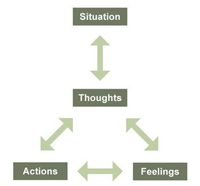
Cognitive Behavioral Therapy is a type of talk therapy that’s used to treat a wide range of mental health problems from depression and eating disorders to phobias and obsessive compulsive disorders. It recommends looking at ourselves in a different way that might prove useful for all of us in everyday life. Read about it’s benefits from this article in the BBC News and why I use it as one way to create positive change in therapy.
Cognitive Behavioral Therapy
“Emotional reasoning is a very common error in people’s thinking,” explains Dr Jennifer Wild, Consultant Clinical Psychologist from Kings College London. “That’s when you think something must be true because of how you feel.”
CBT tries to replace these negative thinking styles with more useful or realistic ones.
This can be a challenge for people with mental health disorders, as their thinking styles can be well-established.
To read the entire listing from The BBC Website Click Here: http://www.bbc.co.uk/science/0/23590545
 feeling of intense or growing anger. It is associated with the fight-or-flight response and often activated in response to a serious offense. The phrase, ‘thrown into a fit of rage,’ expresses the immediate nature of rage. We often hear about “road rage” regarding people expressing their anger while driving. If left unchecked rage may lead to violence. Depression and anxiety lead to an increased susceptibility to rage and luckily there is therapy and treatment for rage.
 He does something that you dislike and you get upset. (Conclusion: his behavior dictates your happiness.
 The Guardian Weekly (British Newspaper) dated 11/29/13. Most psychiatrists agree that antidepressants work for people with severe illness but are not supposed to be the first resort for those with mild depression. The article supports the use of antidepressants but says that, “Experience broadly shows that while antidepressants can be effective at treating symptoms of depression, it is talking therapies that will help patients understand what is happening to them, and how to avoid relapse. The chances of a recurrence of depression are far higher in people who do not have some form of psychiatric therapy than for those who do”. We know that drugs do work, but they can’t cure unhappiness. This article supports medication for clinical depression, yet stresses the value of psychotherapy to help people deal with and manage frustration, adversity, sadness and situational dilemmas.
 Therapy is not only about resolving problems. It is also a place to evaluate your life and give recognition to the accomplishments you have that matter to you. This is the basis of self-esteem. Shame is often the biggest offender in blocking us from seeing our strengths and having self-esteem. Therapy can help one look at messages received that result in shame and replace those self messages with self truths. The following passage by Melody Beattie, helps put shame in perspective.
 It can take control out of our life. “What if’s” are a sigh that we have reverted to thinking that people have to react in a particular way for us to be happy. They are also a clue that we may be wondering whether we can trust ourselves to do what’s best for us. Most of the things we worry about, never happen. Try and replace thoughts of fear, with faith in yourself that you know more than you think you do and that you can handle your life well, one day at a time. Sometime that leaves room for dreams where the possibilities are unlimited and things work out with ease.
 we are not really living. Growth demands a temporary surrender of security. It may mean a giving up of familiar but limiting patterns, safe but unrewarding work, values no longer believed in, relationships that have lost their meaning. As Dostoevsky put it, “taking a new step, uttering a new word, is what people fear most. The real fear should be the opposite course.”
 inordinate amounts of time, energy and money to have what the media portrays as ideal female beauty. The problem is that no women look like the air brushed and altered images that is portrayed in advertising. Even Cindy Crawford claims she doesn’t look like her images. Kate Winslet said that she did not look like an altered picture of her that was on the cover of a magazine and added that she did not want to look like that. The struggle to reach an unreachable goal can easily result in low self-esteem, anorexia, bulimia, depression, anxiety and shame.
 The treatment for this is long, inconvenient and controversial. Family therapy can often help members understand how it affects each family member and how to be supportive, empathetic and help the one you love. This article from the July issue of the New Yorker Magazine, is the best I have ever read which includes facts about the disease and the latest information on treatment. Please share it with anyone you know who could benefit.
 meet on line and